Recyclable PCBs that Minimize the Waste of Demo and Eval Boards
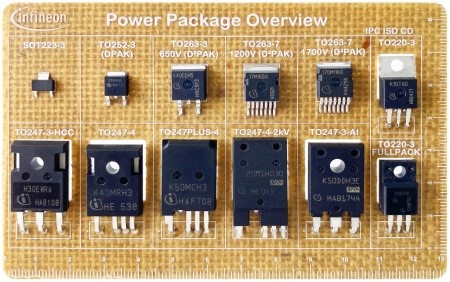
Infineon has developed three PCBs based on Jiva Material’s Soluboard substrate, which breaks down in hot water for easier recovery of the electronic components. (Source: Infineon)
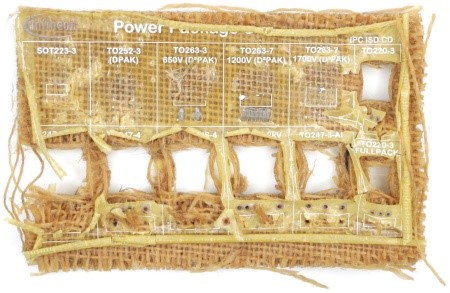
The Soluboard structure is enclosed in a non-toxic polymer that dissolves when immersed in hot water (shown), leaving only compostable organic material. This not only eliminates PCB waste but also allows the electronic components soldered to the board to be recovered and recycled. (Source: Infineon)
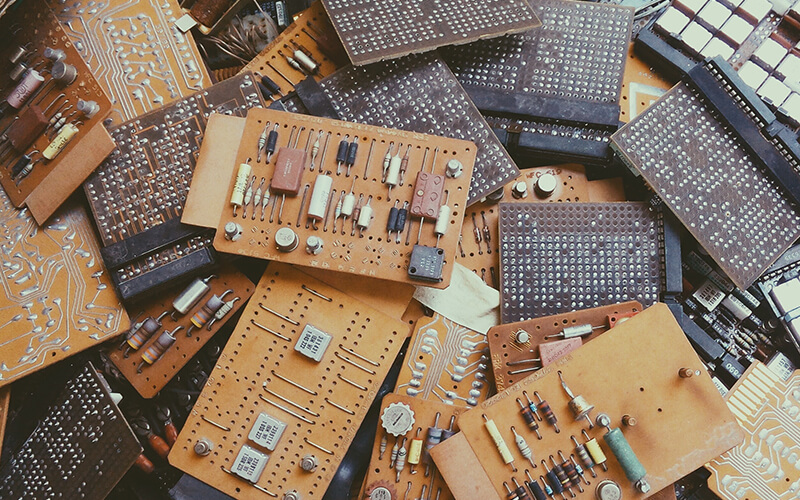
Given that 50 million tons of electronic waste are produced globally every year and only 15.5 percent of e-waste is being handled correctly (source: United Nations University), it’ s not surprising that businesses are looking for ways to reduce their carbon footprints and adopt more sustainable practices.
Reducing the electronic waste generated by printed circuit boards (PCBs) can be an important step to promoting sustainability and creating a greener future. This is why Infineon Technologies AG is introducing Soluboard, a recyclable and biodegradable PCB substrate based on natural fibers and a halogen-free polymer. The product was developed by UK start-up, Jiva Materials, and is expected to help reduce the carbon footprint of the electronics industry.
Soluboard’s plant-based PCB material is made from natural fibers, which have a much lower carbon footprint than the traditional glass-based fibers used in FR-4. The organic structure is enclosed in a non-toxic polymer that dissolves when immersed in hot water, causing the layers of the composite material to delaminate, leaving only compostable organic material that can be disposed of using standard domestic wastewater systems. This not only eliminates PCB waste but also allows the electronic components soldered to the board to be recovered and recycled.
“For the first time, a recyclable, biodegradable PCB material is being used in the design of electronics for consumer and industrial applications—a milestone towards a greener future,” said Andreas Kopp, head of Product Management Discretes at Infineon’s Green Industrial Power Division. “We are also actively researching the reusability of discrete power devices at the end of their service life, which would be an additional significant step towards promoting a circular economy in the electronics industry.”
The use of natural fibers and the polymer they are impregnated with contribute significantly to the reduction in the carbon footprint of the PCB compared with the epoxy and glass fiber used in FR-4. Dissolving a circuit board made from Soluboard allows for 90 percent of its components to be reclaimed and then either repurposed or recycled.
“Adopting a water-based recycling process could lead to higher yields in the recovery of valuable metals,” said Jonathan Swanston, CEO and co-founder of Jiva Materials. “In addition, replacing FR-4 PCB materials with Soluboard would result in a 60 percent reduction in carbon emissions—more specifically, 10.5 kg of carbon and 620 g of plastic can be saved per square meter of PCB.”
Currently, Infineon is using the biodegradable material to reduce the carbon footprint of demo and evaluation boards but is also exploring the possibility of using the material for all boards to make the electronics industry more sustainable. In doing so, Infineon is following the European Commission's Green Deal agenda, which aims to achieve climate neutrality by 2050 by making circularity the mainstream in our lives and accelerating the greening of the EU economy. In addition, the company is committed to the responsible collection and recycling of electronic products manufactured by Infineon in accordance with the EU Directive on Waste of Electrical and Electronic Equipment (WEEE).
Infineon has produced three different demo boards using Soluboard technology and plans to expand its offering over the next few years. More than 500 units are already in use to showcase the company’s power discretes portfolio, including one board that features components specifically for refrigerator applications. Based on the results of ongoing stress tests, the company plans to provide guidance on the reuse and recycling of power semiconductors removed from Soluboards, which could significantly extend the lifetime of the electronic components.
Negating the need to incinerate material is accompanied by a significant reduction in carbon that is released into the atmosphere. The carbon footprint of one square meter of Soluboard PCB is estimated to be 7.1 kg and the carbon footprint of one square meter of standard FR-4 PCB is estimated to be 17.7 kg. This equates to a carbon footprint reduction of 60 percent overall. There is also a significant plastic saving of 620 g per square meter of Soluboard compared to FR-4. Recycled metals can see up to a 95 percent smaller carbon footprint in comparison to newly processed raw materials
The main driver of the carbon and plastic savings is the density of Soluboard. The density of 1.35 g per cubic centimeter of Soluboard compared to 2 g per cubic centimeter of FR-4 leads to a difference in mass of almost 1 kg per square meter. This difference in mass greatly reduces the carbon and plastic impacts of Soluboard compared to the lifecycle of an FR-4 PCB.
Jiva Materials is collaborating with European manufacturers to commercialize Soluboard and the company reports it has secured long-term access to a continued raw material supply.
The company has tested the Soluboards manufactured to date to prove that it is flame retardant to the same extent as other PCB substrates. They are continuing to investigate multiple electronics market segments that the recyclable properties of Soluboard could be beneficial for. Java Materials reports it is currently investigating single and double-sided PCB technology.
Jiva Materials also is optimizing Soluboard so that it can be used with additive methods (conductive silver ink and copper sintering) and subtractive methods (traditional copper foil etching).
Jiva Materials will be licensing the manufacture of Soluboard. These licenses will be influenced by geography and be based on the intended industry application sector