Board-Level Power Conversion: A Focus on Passive Components
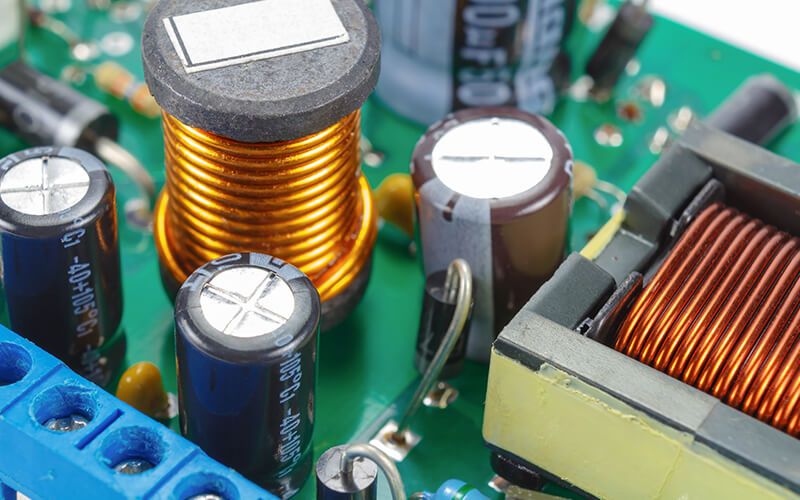
Power conversion is crucial for modern electronic systems, ensuring devices receive stable and efficient power. In most applications, power must be converted from one voltage to another. For example, the PC or phone you may be using to read this article requires AC wall power to be stepped down to the specific voltage your device needs.
Another example would be converting the power from an electric vehicle's battery pack to the voltage required to operate the vehicle's infotainment system. This process not only involves stepping down the voltage but also managing the power efficiently to prevent excessive battery drain and ensure the infotainment system operates reliably. Printed circuit boards (PCBs) integrate numerous components to manage power, with passive components playing a pivotal role. This article highlights the significance of resistors, capacitors, inductors, transformers, and ferrite beads in board-level power conversion.
Resistors
Resistors are fundamental components in electronic circuits, serving multiple critical functions in power conversion systems. They are employed in voltage divider networks to provide stable reference voltages for DC-DC converters. For instance, a precision voltage divider generates a stable reference for the feedback loop in a buck (step-down) converter, ensuring accurate output regulation. The resistors in these networks must have low temperature coefficients and high precision to maintain accuracy over a wide range of operating conditions.
- Power resistors are designed to handle high power dissipation and are crucial in current-limiting applications. These resistors protect sensitive components from excessive current by dissipating energy as heat. Materials such as wire-wound or metal oxide are often used in power resistors to withstand high temperatures and provide long-term reliability. However, wire-wound resistors can exhibit inductive properties, which may interfere with circuit performance in high-frequency applications. In some RF circuits, however, this inductance can be beneficial and is sometimes deliberately exploited.
- Current sensing is another vital role played by resistors in power conversion circuits. Shunt resistors, specifically designed with low resistance values, are placed in the current path to develop a voltage proportional to the current flow. This voltage is measured—often using operational amplifiers (op-amps) for enhanced accuracy—and used by control circuits to monitor and regulate the current.
Accurate current sensing is essential for implementing protection mechanisms, such as overcurrent protection and optimizing the performance of power converters. Precision shunt resistors with low temperature coefficients and high stability are critical in achieving accurate current measurements. Techniques such as Kelvin connections, which use separate pairs of terminals for the current path and voltage measurement, are employed to minimize the effects of parasitic resistance and enhance measurement accuracy.
Capacitors
Capacitors are indispensable in power conversion circuits due to their ability to store and release energy rapidly. They come in various types, each suited for different applications.
- Ceramic capacitors are known for their low equivalent series resistance (ESR) and high-frequency performance, making them ideal for decoupling and filtering applications in high-speed circuits. However, they can exhibit capacitance changes with temperature and applied voltage, which affects their suitability for some precision applications. Polymer aluminum capacitors are also known for their low ESR.
- Electrolytic capacitors are essential for reducing ripple voltage, ensuring a stable DC output from an AC input. These capacitors typically have high capacitance values and low ESR to effectively filter out low-frequency ripple and provide a smooth DC output. A combination of low ESR polymer electrolytic capacitors and ceramic capacitors can significantly improve the efficiency and stability of power supplies by reducing power losses and minimizing voltage fluctuations. It’s important to note that electrolytic capacitors are polarized, meaning they must be connected with the correct polarity to avoid damage or failure, which can include capacitor rupture or explosion.
- Multi-layer ceramic capacitors (MLCCs) are often used in decoupling applications due to their excellent high-frequency characteristics and low inductance. Using MLCCs in parallel can further enhance decoupling performance by providing a wider frequency range of noise suppression.
- Film capacitors are known for their stability, low dielectric absorption, and high voltage capabilities. They provide excellent performance in circuits requiring high-frequency stability and low loss. Film capacitors are often chosen for applications requiring the ability to handle high voltages and where long-term stability is crucial. They are frequently used in resonant circuits, where their low loss characteristics are critical for maintaining a high Q-factor and efficient energy transfer.
- Tantalum capacitors are valued for their high capacitance density and reliability, making them suitable for applications where space is limited and stable capacitance is required over a wide temperature range. Their robust construction and long life make them ideal for demanding applications such as aerospace and military electronics. However, they should be derated in high-stress applications to avoid failure due to surge currents.
- Supercapacitors offer extremely high capacitance values and can store and release large amounts of energy rapidly. They are used in applications requiring high power density and fast charge/discharge cycles, such as backup power supplies, regenerative braking systems in electric vehicles and energy harvesting systems. The integration of supercapacitors with traditional capacitors and batteries can create hybrid energy storage solutions that combine the high energy density of batteries with the high-power density and long cycle life of supercapacitors.
Inductors
Inductors store energy in a magnetic field and are vital in filtering and energy storage applications within power conversion circuits. In step-down (buck) or step-up (boost) converters, inductors smooth the pulsating voltage from switching MOSFETs, providing a steady current to the load. The inductor's role in these converters is critical, as it directly affects the efficiency, ripple current, and overall performance of the power supply.
- The type of inductor affects its performance in terms of inductance value, current handling, and size. For example, air-core inductors are typically larger due to the need for more turns to achieve the same inductance without a magnetic core, leading to higher copper losses. However, they are often used in high-frequency applications where core losses in other types of inductors would be significant. Powdered iron-core inductors provide higher inductance values and better efficiency but can suffer from core saturation and losses at high frequencies. Ferrite-core inductors offer a good balance between size, efficiency, and frequency performance, making them suitable for a wide range of power conversion applications.
- Advanced inductor designs incorporate techniques such as shielding and interleaved winding to improve performance. Shielding reduces electromagnetic interference (EMI), while interleaved winding, more common in transformers, reduces leakage inductance and improves coupling. These design considerations are critical in achieving high-efficiency power conversion and meeting the stringent requirements of modern electronic systems.
Transformers
Transformers are key components in isolating and converting voltages within power supplies. They operate on the principle of electromagnetic induction, transferring energy between primary and secondary windings. In power conversion applications, transformers serve multiple functions, including voltage step-up, step-down, and galvanic isolation, which enhances safety and noise immunity.
Transformers are critical in applications such as power distribution and electronic power supplies, where voltage levels need to be adjusted to meet specific requirements. In utility power distribution, large transformers step up voltages for transmission and step-down voltages for distribution to consumers. In electronic power supplies, smaller transformers are used for similar purposes but at much lower power levels.
- High-frequency transformers, used in Switch-Mode Power Supplies (SMPS) and other high-frequency applications, are designed to operate at frequencies ranging from tens of kilohertz to several megahertz. High-frequency operation allows for smaller transformer sizes and improved efficiency compared to low-frequency designs.
- Isolation transformers provide galvanic isolation, enhancing safety by preventing direct electrical connection between the input and output. This isolation is crucial in medical devices, industrial controls, and other applications where safety and noise immunity are paramount.
- Flyback transformers combine the functions of voltage conversion and isolation, enabling compact and efficient designs. Flyback transformers operate by storing energy in the core during the switch-on period and transferring it to the secondary during the switch-off period. Flyback transformers are typically used in lower-power applications, but with modern advancements in switching frequencies and materials, they can also be used in higher-power applications, especially in isolated power supplies. Advanced flyback transformer designs incorporate techniques such as multi-output windings and integrated inductors to improve performance and reduce component count.
Ferrite Beads
Ferrite beads are passive components used to suppress high-frequency noise in power conversion circuits. They act as low-pass filters, providing high impedance to high-frequency signals while allowing low-frequency signals to pass through. By attenuating EMI, ferrite beads enhance power supply performance and reliability, especially in environments with significant RF noise.
Ferrite beads are commonly used in power lines, signal lines and ground lines to suppress conducted EMI and improve signal integrity. Essentially, they act as frequency-dependent resistors, which helps in understanding their operation as low-pass filters.
In power conversion circuits, ferrite beads are often placed at the input and output of power supplies to filter high-frequency noise generated by switching transients. The beads help to prevent noise from propagating into other parts of the circuit or external devices. The selection of ferrite beads involves considering factors such as impedance at the target frequency, current handling capability, and temperature stability.
Ferrite beads can also be used in conjunction with capacitors and inductors to form LC filters, providing enhanced filtering performance. These filters are designed to target specific frequency ranges and attenuate noise effectively. The design and placement of ferrite beads and LC filters are critical in achieving low-noise power conversion systems that meet stringent EMI standards.
Conclusion
Passive components are the cornerstones of board-level power conversion, ensuring efficient and reliable operation of electronic systems. Resistors, capacitors, inductors, transformers, and ferrite beads each play a crucial role, from energy storage and filtering to voltage conversion and noise suppression. By understanding their applications and selecting the right components, you can design robust power conversion circuits that meet the stringent requirements of modern electronics.
At TTI, we understand the challenges of designing efficient power conversion circuits. Our extensive inventory of top-quality passive components, along with our expert support, ensures you have the right components for your projects. Contact TTI today to learn how we can help you enhance your power conversion designs and achieve unparalleled performance in your electronic systems.
Follow TTI, Inc. on LinkedIn for more news and market insights.
Statements of fact and opinions expressed in posts by contributors are the responsibility of the authors alone and do not imply an opinion of the officers or the representatives of TTI, Inc. or the TTI Family of Specialists.
Follow TTI, Inc. - Europe on LinkedIn for more news and market insights.
Statements of fact and opinions expressed in posts by contributors are the responsibility of the authors alone and do not imply an opinion of the officers or the representatives of TTI, Inc. or the TTI Family of Specialists.